


Fireworks AI, an AI inference provider, has now described two separate security incidents in October 2026, one from August 3 to October 7 and one from October 23 to October 30. The second came through a third-party cloud provider hosting its research machines, and billing data, resource metadata and, for some customers, datasets and incomplete model weights were accessed. For risk teams, the case is a clear lesson in AI vendor risk: the AI services your business relies on sit on supply chains you rarely see.
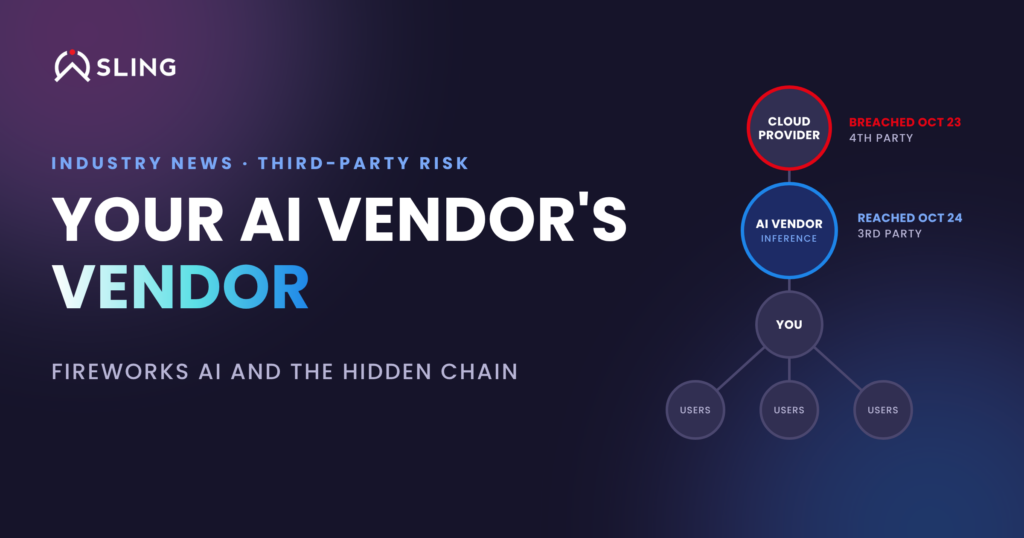
The short version: two intrusions and at least three layers of companies. A cloud provider was hit, which exposed Fireworks, which in turn reached Fireworks customers such as Notion and, through Notion, some of its users. For third-party risk management (TPRM) teams, the Fireworks AI breach shows why AI vendors need the same scrutiny as any other critical provider.
Key takeaways
- On November 17, 2026, Fireworks updated its bulletin to describe two separate incidents, August 3 to October 7 and October 23 to October 30, and says both are now contained and remediated.
- The second incident came through an unnamed third-party cloud provider that hosted Fireworks research and development machines, a fourth-party risk for Fireworks customers.
- Fireworks says account and billing information for all accounts created before October 30 was accessed, and that a small number of customers had secrets, models or datasets accessed.
- In its November 9 update, Fireworks linked the activity to a financially motivated group that sells stolen access to large language models (LLMs), a practice known as LLMjacking.
- Notion told some customers that unattributable AI chat sessions may have been exposed in fewer than 1% of workspaces, and Fireworks hasn’t published a customer count.
What happened in the Fireworks AI breach?
Fireworks AI runs and fine-tunes open AI models for other companies. Customers send it prompts, datasets and model weights, and connect it to their products through application programming interface (API) keys.
What has been confirmed
The first activity was detected on October 6, 2026. According to Fireworks’ original bulletin, someone used internal Fireworks credentials to read environment variables in evaluation jobs for a limited number of accounts, capturing API keys and tokens stored as secrets. At that point, Fireworks said it saw no evidence that models, datasets or personal information had been accessed.
That picture changed twice. The November 9 update said a third-party cloud provider hosting Fireworks research and development machines had a security incident on October 23, and that the attacker used that access to reach Fireworks development machines the next day. The November 17 entry on the same page then split the activity into two incidents:
- First incident, August 3 to October 7, 2026: the attacker used stolen Fireworks credentials and a vulnerability in one of its services. For a small number of customers, secrets, model files and datasets were accessed. Unit 42 has completed its forensic investigation, and Fireworks says the incident is contained and remediated.
- Second incident, October 23 to October 30, 2026: the attacker reached development machines hosted on a third-party cloud provider that had its own incident, then part of Fireworks production systems. Account and billing information for all accounts created before October 30 was accessed, along with datasets, models or secrets for a small number of customers. Fireworks says this incident is also contained and remediated, and its forensic investigation is ongoing.
Fireworks says payment card numbers are not stored and were not affected, and that it saw no impact on its zero data retention inference service. The company engaged Palo Alto Networks’ Unit 42 and disabled self-serve dataset uploads and downloads during the investigation.
What is still unknown
The cloud provider hasn’t been named. Fireworks hasn’t published how many customers were affected, saying only that a small number had secrets, models or datasets accessed. The link to an LLMjacking group is Fireworks’ own assessment from its November 9 bulletin, not a confirmed attribution.
Who was affected?
Fireworks is notifying affected customers directly and has not published a list. The Register reported that Notion told at least one customer that fewer than 1% of Notion workspaces may have been affected, with some unattributable Notion AI chat sessions possibly exposed. Bloomberg named Cursor and Harvey as customers Fireworks was working with to assess impact, according to the same report.
That chain matters. A Notion user never signed a contract with Fireworks, and Fireworks’ customers never signed one with its cloud provider. The exposure still traveled down the line.
Why does the Fireworks AI breach matter for AI vendor risk?
The Fireworks AI breach is an AI vendor risk story more than an AI story. Four lessons stand out for vendor risk teams.
Your AI vendor’s vendor is part of your attack surface
The second intrusion didn’t start at Fireworks. It started at a cloud provider most Fireworks customers had never heard of. That is fourth-party risk: exposure that comes from your vendors’ own vendors.
Why that layer deserves attention is covered in Should you evaluate 4th party risk management?. AI services make the chain longer, because model hosting, graphics processing unit (GPU) capacity and tooling are often outsourced again.
AI vendors hold more than data
Most vendor reviews ask whether a provider stores personal data. AI providers also hold API keys, fine-tuning datasets, model weights and chat histories. Fireworks’ first incident was about secrets, not records: stolen keys can be reused to run AI workloads at the victim’s expense.
LLMjacking turns stolen keys into bills
Google Threat Intelligence Group and Mandiant reported on November 2, 2026 that some LLMjacking incidents generated more than $100,000 in charges in a single day, and some organizations reached $1 million before access was cut. The dominant entry point was exposed or stolen cloud credentials. A vendor that stores your AI keys becomes a route to your cloud bill.
Early disclosures change
Fireworks’ first bulletin said no datasets or models were touched. A month later, some were, and by November 17 the company was describing two separate incidents. Teams that closed the ticket after the October notice were working from an incomplete picture. Vendor incidents need follow-up until the investigation is closed, not a single check.
What can continuous monitoring do here, and what can’t it?
Monitoring can’t see inside a vendor’s research environment or tell you which cloud provider an AI vendor uses for R&D. That takes contractual disclosure and direct questions. What outside-in monitoring can do is flag signals tied to a vendor, such as leaked credentials, compromised accounts, exposed services or breach claims, and keep watching after the first notice.
Sling was built for that outside-in view. The Sling Score combines darknet and criminal intelligence with attack surface mapping, and it needs no agent to install and no consent from the vendor.
What should risk teams do this week?
- Inventory your AI vendors. List every AI model, inference and agent provider in use, including ones bought by individual teams, and add them to your vendor register. The earlier analysis of frontier AI as a third-party risk covers why.
- Check for Fireworks exposure. Ask product and engineering teams whether they use Fireworks AI or tools built on it, such as Notion AI, and review any notification received. Fireworks says account and billing information for all accounts created before October 30 was accessed.
- Rotate AI API keys. Rotate keys shared with any AI provider that reports an incident, and set spending caps and budget alerts on AI services.
- Ask AI vendors about their own vendors. Request the list of hosting and compute providers that touch your data, and how quickly they will tell you when one of them is breached.
- Classify what you send. Record which datasets, model weights and prompts each AI vendor holds, so you know what an incident would expose.
- Keep vendor incidents open. Track updates until the vendor closes its investigation, and reassess when the scope changes.
Bottom line
The second Fireworks AI incident started at a cloud provider and ended in Notion chat sessions. AI services add new layers to the supply chain, and each layer holds keys, data and models. AI vendor risk belongs in the vendor risk program now, tiered and monitored like any other critical provider.
CTA: See the vendors behind your vendors, including your AI providers. Request a vendor risk assessment
FAQ
What is the Fireworks AI breach? It is a pair of separate incidents at AI inference provider Fireworks AI. The first ran from August 3 to October 7, 2026, and the second from October 23 to October 30, 2026. Attackers accessed API keys, account and billing information and, for a small number of customers, datasets, models and secrets.
How did attackers get into Fireworks AI the second time? They came through a third-party cloud provider that hosted Fireworks R&D machines and had a security incident on October 23, 2026. Fireworks says the attacker used that access to reach development machines and then part of its production systems. Fireworks has not named the provider.
Was Notion affected by the Fireworks AI breach? Notion told at least one customer that fewer than 1% of workspaces may have been affected. Some unattributable Notion AI chat sessions may have been exposed, according to that notice.
Is the Fireworks AI incident over? Fireworks says both incidents are contained and remediated, and that Unit 42 has completed its forensic investigation of the first. The investigation into the second was still ongoing as of the November 17 update.
What is LLMjacking? LLMjacking is the hijacking of an organization’s access to large language models to run workloads at its expense. Google reported incidents costing over $100,000 in a single day.
What is AI vendor risk? AI vendor risk is the exposure an organization takes on when it relies on outside AI model, inference or agent providers. It covers the data, keys and models those vendors hold, and the vendors they depend on.
Sources
- Fireworks AI, October 2026 security incident, October 9, 2026
- Fireworks AI, Update on October 2026 security incident, November 9 and November 17, 2026
- The Register, Fireworks AI gets burned twice as customer data exposure widens, November 10, 2026
- The Hacker News, Fireworks AI Confirms Wider Breach Affecting Customer Datasets, Model Weights and Notion AI Chats, November 10, 2026
- BleepingComputer, Fireworks AI discloses new breach after cloud provider hack, November 10, 2026
- Google Threat Intelligence Group and Mandiant, The Rise of LLMJacking: How Threat Actors Monetize Compromised Cloud and Model Resources, November 2, 2026