

Most vendor risk programs share the same quiet problem: the team sends out questionnaires, follows up on late responses, reviews answers of varying quality, and files everything away — only to repeat the process next year. Meanwhile, actual risk decisions often come down to gut feel, procurement pressure, or whoever raised a concern loudest.
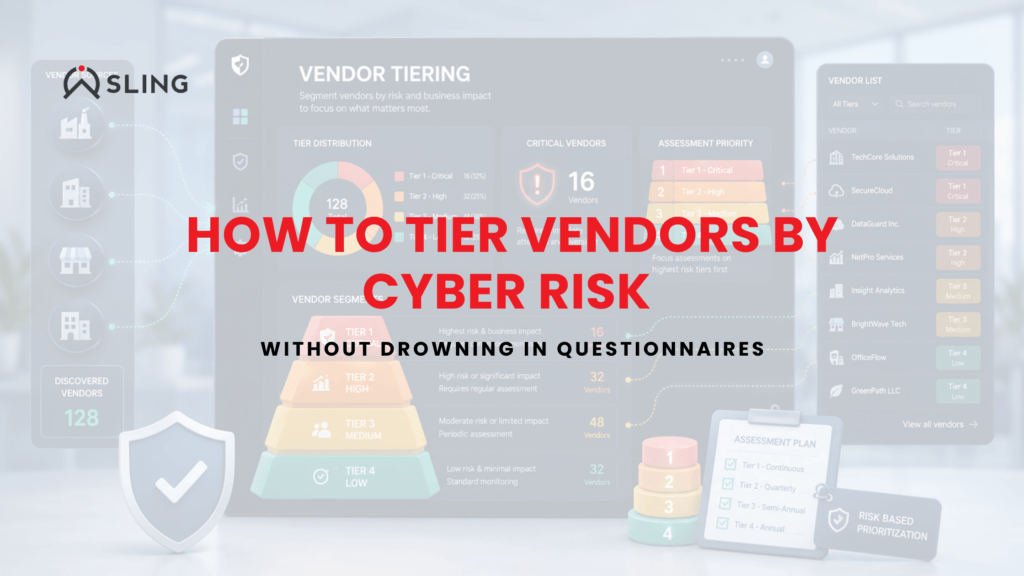
Vendor risk tiering is the fix. When done well, it tells you which vendors deserve intensive scrutiny, which warrant a lighter touch, and which can be managed through contract terms alone. It turns a flat, undifferentiated vendor list into a prioritized workload — one your team can actually manage.
This guide walks through a practical tiering framework designed for lean teams who need to work smarter, not just send more questionnaires.
Why Questionnaire Volume Is Not Risk Coverage
Before getting into the framework, it helps to name the core misconception driving a lot of overworked TPRM programs.
Sending a questionnaire is not the same as understanding risk. A completed questionnaire tells you what a vendor says about its security posture. It does not tell you what your exposure looks like if that vendor is compromised, how quickly you would know about an incident, or whether the controls they claim are actually functioning.
Volume-based approaches also create a coverage illusion. If your team has assessed 300 vendors this year, it feels like the program is running. But if those 300 assessments were applied equally across critical infrastructure providers and low-stakes software tools, you have not allocated oversight in proportion to actual risk.
Tiering solves this by answering a prior question: before asking how a vendor manages security, ask how much it matters if they do not.
The Core Logic of Vendor Risk Tiering
Vendor risk tiering is the process of classifying vendors into groups based on their potential impact on your organization — so you can calibrate how much oversight, documentation, and ongoing monitoring each one warrants.
The goal is not to find the perfect tier for every vendor. The goal is to make defensible, consistent decisions that let your team focus on what matters most.
A workable tiering model rests on two factors:
- Access and exposure — What can this vendor touch? Data, systems, operational processes, customer information?
- Dependency and criticality — What breaks if this vendor fails or is compromised?
Multiplying these two dimensions gives you a rough risk score. High access plus high criticality equals your Tier 1 vendors — the ones that warrant full assessment cycles, ongoing monitoring, and executive-level visibility. Low access plus low criticality means lighter controls are appropriate.
A Practical Three-Tier Framework
Tier 1 — Critical Vendors
Who they are: Vendors with significant access to sensitive data or systems, or whose disruption would materially affect your operations, customers, or regulatory standing.
Examples: Core infrastructure providers, payroll and HR platforms, cloud hosting, major SaaS tools that process customer data, any vendor embedded in your incident response capability.
Oversight approach:
- Full security questionnaire or evidence-based assessment (SOC 2, ISO 27001 review)
- Annual reassessment minimum; more frequent for high-change vendors
- Continuous monitoring for threat intelligence signals
- Documented incident response and escalation procedures
- Executive or board-level reporting for any material findings
Tier 2 — Important Vendors
Who they are: Vendors with meaningful but bounded access, or where disruption would cause significant operational friction without rising to a critical threshold.
Examples: Marketing automation tools, collaboration platforms, secondary data processors, niche software used by specific teams.
Oversight approach:
- Abbreviated questionnaire or standardized control checklist
- Biennial reassessment, or triggered by contract renewal or vendor security events
- Periodic monitoring; alerts on major incidents or relevant threat intelligence
- Standard contractual security requirements
Tier 3 — Low-Risk Vendors
Who they are: Vendors with limited or no access to sensitive systems or data, and where disruption would have minimal operational impact.
Examples: Catering services, office supplies, event vendors, software with no data integration.
Oversight approach:
- No formal security assessment required
- Standard contract terms and vendor code of conduct
- No ongoing monitoring needed
How to Build Your Tiering Criteria
A tiering framework only works if it produces consistent results across whoever applies it. That means documenting the criteria your team uses to classify vendors — not leaving it to judgment calls made differently by different people.
Here are the questions to build your criteria around:
Data access:
- Does this vendor process, store, or transmit personal data, financial data, or regulated information?
- Is the data volume or sensitivity significant?
System access:
- Does this vendor have access to internal networks, privileged accounts, or production systems?
- Could a compromise of this vendor’s systems provide a pathway into yours?
Operational dependency:
- Would a vendor outage affect your ability to serve customers or operate core processes?
- Is there a viable backup or workaround, or is this vendor a single point of failure?
Regulatory exposure:
- Does this vendor relationship create specific compliance obligations (HIPAA, SOC 2, GDPR, PCI)?
- Would a vendor incident trigger mandatory reporting?
For each question, define threshold answers that indicate Tier 1, Tier 2, or Tier 3 placement. This gives you a tiering matrix your team can apply consistently — and that you can show auditors, regulators, or board members as evidence of a structured approach.
Common Pitfalls to Avoid
Treating tiering as a one-time exercise. Vendor relationships change. A tool that started as a low-risk productivity app can become a Tier 1 risk after an integration that pulls in customer data. Build a process for re-evaluating tier assignments when vendor scope expands or contracts change.
Using spend as a proxy for risk. High-cost vendors are not necessarily high-risk vendors, and vice versa. A cheap API that touches sensitive data may be far more consequential than an expensive event catering contract. Tiering should follow risk characteristics, not invoice size.
Creating too many tiers. Four or five tiers might feel more precise, but they usually create more confusion than clarity — especially when the distinctions between adjacent tiers are hard to explain. Three tiers is enough for most programs.
Failing to connect tiers to action. The point of tiering is to drive different oversight behaviors. If Tier 1 vendors and Tier 2 vendors receive identical treatment, the tiers are not doing any work. Define what changes at each level.
Where Continuous Monitoring Fits In
Questionnaires are a point-in-time snapshot. A vendor can answer every question correctly in January and experience a major breach in March. Tiering helps you decide where to focus, but monitoring is what keeps your visibility current between formal assessment cycles.
For Tier 1 vendors especially, monitoring external signals — threat intelligence feeds, breach disclosures, regulatory actions, dark web exposure — gives you early warning that a vendor’s risk profile has changed. This is not a replacement for periodic assessments; it is the layer between them.
The combination of risk-based tiering and continuous monitoring is what moves a vendor risk program from a compliance exercise to an operational capability.
Key Takeaways
- Questionnaire volume does not equal risk coverage. Tiering lets you allocate oversight proportionally.
- A three-tier model based on access, criticality, and dependency is sufficient for most programs.
- Document your tiering criteria so classifications are consistent, defensible, and auditable.
- Tier assignments should change when vendor scope or your dependency on a vendor changes.
- Continuous monitoring extends coverage between formal assessments, especially for Tier 1 vendors.
FAQ
What is vendor risk tiering? Vendor risk tiering is the process of classifying your vendors into groups based on their potential impact to your organization — typically by evaluating their access to sensitive data or systems and your operational dependency on them. The goal is to match the level of oversight to the level of risk, so your team’s time and resources are spent where they matter most.
How many tiers should a vendor risk program have? Three tiers work well for most organizations. A Tier 1 (critical), Tier 2 (important), and Tier 3 (low risk) structure provides enough differentiation to drive meaningfully different oversight without creating so many categories that the distinctions become hard to apply consistently.
Should I assess every vendor before tiering them? No. Tiering comes first. You need to understand a vendor’s potential impact before deciding how deeply to assess them. A lightweight intake questionnaire focused on access and dependency is enough to assign a tier. Full assessments are then applied to Tier 1 and, where appropriate, Tier 2 vendors.
How often should I re-evaluate vendor tier assignments? Tier assignments should be reviewed at contract renewal, whenever a vendor’s scope of access changes, or when your dependency on them shifts materially. A full portfolio review annually is a reasonable baseline.
Can I tier vendors without dedicated TPRM software? Yes, a spreadsheet-based tiering matrix can work for smaller vendor populations. However, as your program scales, manual processes become hard to maintain consistently. Purpose-built tools help automate intake, apply tiering criteria systematically, and surface changes that warrant reassessment.
How does vendor risk tiering relate to continuous monitoring? Tiering determines where monitoring is warranted and at what intensity. Tier 1 vendors typically warrant ongoing external monitoring between formal assessments. Tier 2 vendors may be monitored periodically. Tier 3 vendors typically do not require active monitoring. The two practices reinforce each other: tiering directs your monitoring resources; monitoring keeps tier assignments current.